Sunday, 28 September 2014

Draft Version of Continuity Editing

Draft Version of Continuity Editing

After this week with the help from the rest of my group I managed to complete the first version of my scene. This is only the draft version and is used to show the basic plot and story of the scene. Over the next week I will be looking to re-film potential shots as well as complete the final version. 

I managed to edit the first version together during the Edit Workshop on Thursday. During this time I used an iMac along with the default video editing software iMovie. I had a total of 1 hour 10 minutes to import all the footage and edit together as much of the first version as possible. During this time I used multiple tools and managed to complete the main story/plot but it still needs more footage added in as well as refined editing.


Friday, 26 September 2014

Complete Group Storyboards

Storyboards
From last week, this week we also updated our groups storyboards, most of the story board was identical as the previous one except for the fact that we had to re-draw a few of the shots which didn't accurately show all of the shot types, for example a close up would not be represented by a picture/drawing of a close up and rather a mid shot instead.
--------------------------------------------------------------------------------------------------------------------------
--------------------------------------------------------------------------------------------------------------------------


--------------------------------------------------------------------------------------------------------------------------
--------------------------------------------------------------------------------------------------------------------------
--------------------------------------------------------------------------------------------------------------------------

--------------------------------------------------------------------------------------------------------------------------

--------------------------------------------------------------------------------------------------------------------------


Continuity Editing Introduction

Continuity Editing Introduction

My Ideas
In my group, we decided to create a a story based upon the brief but make it a lot more in depth with a much more exciting and intense story and theme. Our story is based upon the kidnapping of a person and the interrogation of him because of an unknown purpose, the reason we left this unknown is because it leaves the story ambiguous and for the audience to create their own story in their head, this means that they automatically side with the victim in the situation but are unsure why. This leaves them feeling the intensity and the suspense of the scene. Our idea is set in an empty vacant room in a building of which the audience doesn't know, the reason I chose this is because it leaves the room without any emotion, therefore the audience cannot find anything to liven up the mood of the scene.


Example showing how empty the room is.
That is the general plot of the story and I think that it is good at creating a a dramatic and suspense filled scene, This is because the scene is based upon a situation in which most people aren't familiar with, it sets an uncomfortable situation for people when watching especially considering that it could happen to anyone, which sort of builds up suspense as the audience feels as though it can happen to them as well. 

Throughout the scene we made sure to include a lot of different editing techniques, for example we made sure to follow the 180 degree rule, match on action as well as shot-reverse-shot. The 180 degree rule states that during a scene the camera should not cross the line of vision once and any movements should be made only on one side of it. This is because it helps to stop the audience feeling confused when they are watching the scene. For example we included a match on action shot. This is two clips that are synced together to cut during motion, while still looking as though it is realistic. This means that the shots have to be cut very precisely so that the edit is almost seamless. We decided to this with the door opening on the outside and the cutting to the inside view.

The first two are used because it stops the audience from getting confused when watching. The shot-reverse-shot has been used throughout our project about half way through to show the conversation between the interrogator and the hostage. This shot will help the audience because it will help show both peoples responses and/or reactions during a specific moment of the scene.


Another key rule that we used was the rule of thirds. This rule is used to correctly align all of the participating actors in the scene so that they appear correctly on the screen. Almost always should the eyes match the line of the top third of the screen. This is to help stop the audience from feeling confused about the character and their size during the scene. In addition to this depending on whether the shot is supposed to be of the ground or the sky the horizon is made to match the rule of thirds. If it is a shot of the sky the horizon will be on the one third up the screen and if the shot is of the ground the horizon meets two thirds up the screen.


Sunday, 21 September 2014

Week 2 - Recording & Filming

What we did this week
This week we started on our recording our scene, we decided on the story last week as well as creating the storyboard for it. This week we would use the assigned SD cards for our group and assigned equipment which consisted of a video camera as well as a tripod stand to record our shots. In total we recorded on a multiple number of days: Monday, Tuesday, Wednesday and Thursday. We spent most of our lessons recording and often continued on into our free time. 

We also had to decide on where to record, which was a bit of an issue as most rooms had a lot of items inside where as we needed a blank and empty room. We did finally come to a decision to record in our schools conference room as it had very few things inside other than chairs and multiple tables. We ended up moving around them all to suit our scene the best.

Finally in addition to recording video this week we also recorded a wild cat soundtrack and wrote a script for our scene. The script would just outline everything that we needed to say in the shots and the wild cat soundtrack is a recording of ambient (atmospheric) noise. This in our case was the recording of a projector and some sort of electrical whirring. This will be used as a background noise throughout our entire final piece, but subtle and not too loud.

What Techniques we used
This week in Media Studies we were working on recording our one minute sequence using continuous editing. We used a variety of different techniques and camera language whilst filming this week. We had to follow as many of the recording rules as possible, for example throughout filming we made sure to follow the 180 degree rule, this is to make sure that the audience isn't confused by a sudden camera flip during the final piece. To follow this rule we mades sure to keep the camera on the left hand side of the scene at all times. 

Another rule that was important to consider was the Match on action, this means throughout the scene that all locations and positioning of objects or people are the same in all shots unless there is a shot partway through showing the movement of that object/person. Fortunately for us there wasn't too much of this to consider as the setting for our recording was in a empty room, however we did have to include it in our piece, so to do this we used match on action to show the door opening and then cuts to show the door open on the other side of the door. 

We also used the shot-reverse-shot technique when we were recording, this is a type of editing that involves 3 cuts to 3 different shots, the first one has to be the same as the last shot in terms of camera language and character in the shot.
Of course we also had to follow use a wide variety of camera angles and shot types, this we included in our storyboard and also recorded, we used high angles to show weakness and close ups to show the emotion of how someone is feeling.

Evaluation

This week was a mixture of both good and bad, varying from the point in the week. The first 3-4 days were much more negative from my personal experience as they were a lot more stressful for me as we had to record and in some cases re-record many shots which was difficult in such a small time scale of only a week. This was further worsened by the difficulty in finding a time where all of our group could record at the same time, often we found that the best time to record was during lesson as we were all there for the most part, however since we needed extra time that meant it was tricky.

Although it wasn't all bad this week, when I wasn't worried about recording the footage we managed to be able to relax a bit and we did manage to finish all of our recording this week.

In conclusion I think that this week could have gone a lot better, however it was difficult to control as it was due to a limited time scale and people having to leave and do something other than recording in our free time.

Sunday, 14 September 2014

Week 1 - Storyboarding & Camera Language

The first week in Media Studies A-Level we went straight into working on camera language, we had to go over many different elements which made up a scene, first of all we went over the type of shots that you could take such as the long-shot, close up, mid shot, two-shot, establishing shot and over the shoulder shot. We learnt how each shot is used to create more meaning and develop an archetype or a personality for each person. For example a close up can be used to show emotion and how the character is feeling. 

In addition to shot types we also worked on camera angles such as High/Low Angle, Canted Angles as well as transitions and types of editing such as Cut, Fade, Dissolve, Match on Action and Shot-Reverse-Shot. We found out that by using angles we can manipulate the strength of the character, for example a high angle, which would look down upon a person would alter their appearance to look weak and feeble and vice versa for the high angle. Editing and transitions are used to represent the time scale and intensity of the scene. A cut shows virtually no time passing but is abrupt and more intense, so a lot of cut's next to each other would make a very dramatic scene. We also learnt about the match on action where two shots with motion taken from more than one place should try to sync up the actions of the moving object in order to create realism and not confuse the audience.


A high angle shot from The Inbetweeners

Here the high angle makes him look very weak and powerless and is used to make him look like the character who is bullied, which he is in the actual show. 
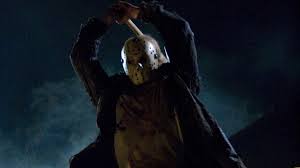


A low angle shot from Friday the 13th


My Ideas and Plot
In my group, we decided to create a a story based upon the brief but make it a lot more in depth with a much more exciting and intense story and theme. Our story is based upon the kidnapping of a person and the interrogation of him because of an unknown purpose, the reason we left this unknown is because it leaves the story ambiguous and for the audience to create their own story in their head, this means that they automatically side with the victim in the situation but are unsure why. This leaves them feeling the intensity and the suspense of the scene. Our idea is set in an empty vacant room in a building of which the audience doesn't know, the reason I chose this is because it leaves the room without any emotion, therefore the audience cannot find anything to liven up the mood of the scene.

In my group, we decided to create a a story based upon the brief but make it a lot more in depth with a much more exciting and intense story and theme. Our story is based upon the kidnapping of a person and the interrogation of him because of an unknown purpose, the reason we left this unknown is because it leaves the story ambiguous and for the audience to create their own story in their head, this means that they automatically side with the victim in the situation but are unsure why. This leaves them feeling the intensity and the suspense of the scene. Our idea is set in an empty vacant room in a building of which the audience doesn't know, the reason I chose this is because it leaves the room without any emotion, therefore the audience cannot find anything to liven up the mood of the scene.